

Five lessons about trust at work from the Make Work Better Conference 2026
Article Summary
- Trust is shaped not only by leaders and managers but by the systems, policies and technology people experience every day.
- Organisations need to build trust before pressure hits so people can ask for help, speak up, adapt and learn when things go wrong.
- High trust should make challenge easier and not agreement more likely: people need to feel safe to question decisions, admit mistakes and raise concerns.
Trust is an easy word to use but a much harder thing to build.
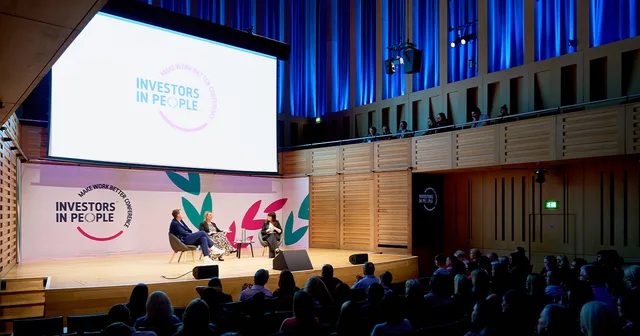
This was one of the clearest messages from Investors in People’s Make Work Better Conference 2026, where speakers approached the subject from very different worlds: HR, academia, business, elite sport, psychology and the military. Repeatedly the speakers came back to what happens when people are under pressure, when something goes wrong or when someone needs to speak up. Here are five lessons that stood out.
Lesson 1. Institutional trust: build trust into how your organisation works in practice
We often talk about trust as something that exists between people. Do employees trust their manager or do they trust the leadership team? Professor Veronica Hope Hailey, emeritus professor of management, challenged HR leaders to look beyond those relationships.
She distinguishes between relational trust – the trust between people – and institutional trust. This is the trust people place in the structures, systems and policies around them. As she put it: “What you do in HR really matters to your trust as an employer and as an employer brand.”
Her example was one most of us can relate to. You do not know the pilot of the plane you board but you trust the training, regulation and checks surrounding that pilot. The same principle applies at work. Employees make judgements about whether performance processes are fair, whether decisions are explained, whether managers apply policies consistently and whether the technology being introduced can be trusted.
This becomes even more important as AI moves into HR systems. Hope Hailey pointed to employees being more comfortable using AI as a productivity tool than having it involved in decisions about them. Her advice was to “turbocharge your relational trust” with trustworthy policies, systems and cultures.
Katherine Chapman, CEO of Investors in People, made a similar point in her opening keynote. Trust is experienced through “leaders, managers and the institution itself – the systems, the processes.”
This means looking beyond values and leadership development. If an organisation says it trusts people but surrounds them with unnecessary approvals, opaque decisions or systems designed around suspicion then employees will notice the contradiction.
Lesson 2. Build trust before you need to rely on it in a crisis
Trust matters when things are going well but it becomes far more important when people are being asked to operate with uncertainty or deal with sudden change.
Hope Hailey captured the problem with an old Dutch proverb: “Trust comes on foot and leaves on horseback.” It takes time to build but can disappear very quickly. Her advice to HR leaders was therefore to invest in trust while things are going well because trying to create it once a crisis has arrived is much harder.
Former UK Special Forces operator, broadcaster and bestselling author Jason Fox gave the most dramatic example of this. He told the story of a hostage rescue in Afghanistan where months of preparation came down to a mission whose circumstances changed almost completely just before the team left.
What did not change was the mission. Their commanding officer told them twice: “Tonight’s mission is to save the life of the hostage.” Fox explained that however badly the plan unravelled this was the thing everyone could return to.
Clarity matters in ordinary workplaces too, especially when organisations are dealing with change and leaders do not yet have all the answers. Chapman argued that leaders can still be open about what they know, what they do not yet know and what will happen next. The point is not to pretend the plan is fixed but to give people enough confidence in the organisation and in the direction of travel that they can keep working when circumstances change. In other words trust has to be built before the difficult moment arrives and not once people are already looking for reassurance.
Lesson 3. Trust is a resilience resource and not simply a culture measure
Resilience is often discussed as something individuals need to develop: how well they manage pressure and whether they can keep going when work becomes difficult. Charlie Cannon, a people performance specialist and resilience and leadership coach, asked the conference to look at it differently. “Trust is a resilience resource,” he said.
When people trust each other they are more likely to ask for help or admit when something has gone wrong. They are also more likely to raise a concern before it becomes a bigger problem. Under pressure, Cannon said, they are more likely to “have each other’s back.” His wider point was that resilience does not sit inside an individual. “Resilience is built around us. It’s built together.”
This shifts the question HR should ask. Instead of focusing only on whether employees are resilient enough organisations should examine the conditions around them. Can people ask for help without worrying about the response? What happens when someone is struggling or the pressure on a team rises? Cannon also challenged the assumption that people can sustain the same intensity indefinitely, arguing that recovery needs to be treated as part of performance rather than something employees sort out in their own time.
Jake Humphrey, broadcaster, co-founder of production company Whisper and host of the High Performance podcast, gave a business example from Covid. Whisper produced live sports content and suddenly found most of its work disappearing. The leadership team told employees how serious the financial position was and shared openly what would need to change. Looking back, Humphrey said trust became the “currency” they relied on.
There’s no sign the pressure facing organisations will disappear. If trust gives people somewhere to turn when this pressure rises it should be seen as part of organisational resilience rather than simply another measure of culture.
Lesson 4. Psychological safety in practice: make it safe – and expected – to say what went wrong
One of the strongest practical ideas of the day came from Fox’s description of how Special Forces teams learn. Before an operation people do not simply have permission to ask questions. They are expected to ask if something is unclear, and Fox stressed that “no one gets ridiculed for stupid questions.”
The same approach continues after the operation through what he called the ‘hot debrief’. Even after the hostage rescue he described, in which one soldier had been killed, the team went straight from their aircraft into the debrief to talk through what had happened. “Everyone has a voice. Everyone is expected to talk about what happened. It is not a witch hunt,” he said.
The point is to understand what happened while it is still fresh and then make sure others can learn from it. After a hot debrief lessons are written up and fed back into training for future teams.
We can sometimes make psychological safety sound more complicated than it is. In practice this is what it looks like: people are expected to speak up, nobody is made to feel stupid for doing so and what they say is used to improve what happens next.
Cannon made a related point about what happens when somebody admits a mistake or brings bad news to a manager: “Your first response teaches them whether it is safe to do it again.”
Petra Velzeboer, CEO of PVL, TEDx speaker and author, pushed this further by arguing that leaders should not simply tolerate challenge. When somebody raises something uncomfortable thank them for doing it and make room for the conversation rather than closing it down.
This is even more important when you consider that IIP’s Trust Paradox research found that 65% of employees had avoided raising or speaking openly about something at work during the previous six months. If people expect irritation, embarrassment or no action at all they will quickly learn to keep things to themselves. A hot debrief works because speaking honestly is part of the job and what people say is then used to improve what happens next.
Lesson 5. Trust and groupthink: don’t mistake agreement for a healthy culture
Perhaps the most challenging lesson of the conference is that trust itself should not become the goal at any cost. Velzeboer drew on her experience of growing up in a highly controlling religious group to show how strong belonging and shared purpose can exist alongside an environment where people learn not to question what is happening. Her warning for organisations was simple: “A trusting healthy organisation is not the same as a compliant one.”
Groupthink is not confined to obviously toxic workplaces. It can happen in good teams when people value harmony or assume that challenging the prevailing view will make life harder. Velzeboer suggested one question teams can use once they appear to have reached a decision: “If we had to argue the opposite of this decision, what would we say?” This question enables people to test the thinking without requiring one individual to become the dissenting voice in the room.
Hope Hailey made a similar argument from another direction. Trust has a “shadow side”, she said, because blind trust can allow poor behaviour to continue without enough challenge. The aim should therefore be to help people judge whether someone or something is trustworthy, rather than assuming more trust is always better.
In the closing discussion Humphrey added a practical example from former England football manager Gareth Southgate. Southgate deliberately avoided speaking first in meetings because he knew his own view could shape what everyone else said afterwards. It’s a good reminder for senior leaders: people may genuinely agree with you but being the most senior person there can also shape what others feel able to say.
This becomes even more important as organisations make decisions about AI and new ways of working where nobody has all the answers. A high-trust workplace should make it easier for people to question a decision or offer a different view without wondering whether they will pay a price for doing so.
About Investors in People
For over 35 years, Investors in People has worked with over 59,000 organisations of every shape and size, from small charities to national PLCs, across the public, private and third sectors. Established by the UK government in 1991 to set a standard for great people practice, and that’s still our purpose today. Our accreditation is recognised around the world as the benchmark for people management, and we’re proud to be part of a community of over 1.1 million people who are working to make their workplaces better. Whatever stage your organisation is at, we speak your language and know how to support you on that journey.
READY TO MAKE WORK BETTER?
Discover how we can assess your organisation against established benchmarks to improve your business performance.